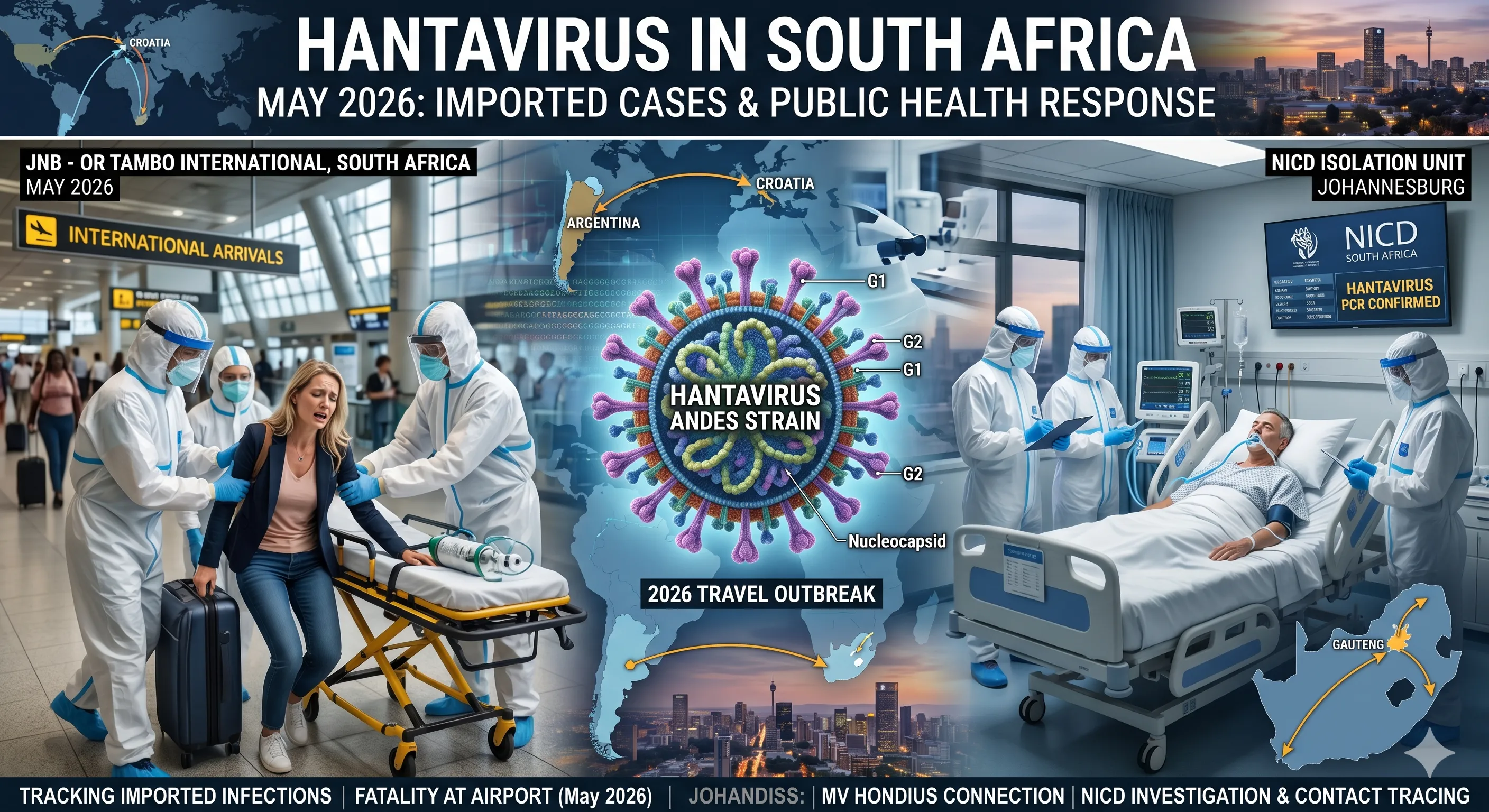
While hantavirus is not considered endemic to South Africa—meaning it does not naturally circulate in the country’s local rodent populations—the nation has become a key site for clinical management and international laboratory investigation following rare imported cases.
The May 2026 MV Hondius Investigation
In early May 2026, South Africa’s National Institute for Communicable Diseases (NICD) confirmed hantavirus in two individuals associated with a cluster of infections aboard the cruise ship MV Hondius.
- Hospitalized Case in Sandton: A British national was medically evacuated from Ascension Island to a private hospital in Sandton, Johannesburg, on April 27, 2026. He was placed in a high-care isolation unit after testing positive for hantavirus via PCR on May 2.
- Airport Fatality: A 69-year-old Dutch woman, whose husband had died earlier on the ship, collapsed at OR Tambo International Airport on April 25, 2026, while attempting to connect to a flight to the Netherlands. She died shortly after arrival at an emergency department, and subsequent PCR testing confirmed she was infected with hantavirus.
- Public Health Action: The Gauteng Health Department and the NICD launched urgent contact tracing for passengers who shared the April 25 flight to Johannesburg to monitor for potential secondary spread.
Historical Context: The 2021 Case
Prior to the 2026 incident, South Africa recorded its first human case of hantavirus in May 2021. This was an imported infection involving a South African traveler returning from Croatia, where the Puumala virus is endemic. The patient presented with acute fever and renal dysfunction, highlighting the risk that international travel poses for the introduction of rare pathogens.
Risk Assessment and Prevention
Despite these high-profile incidents, health authorities maintain that the risk to the general South African public remains very low.
- No Endemic Spread: There is currently no evidence of hantavirus transmission occurring within South African borders from local wildlife.
- Clinical Vigilance: The NICD continues to conduct advanced genomic sequencing and metagenomics to identify specific strains and potential exposure sources.
- Traveler Safety: Health officials advise travelers returning from areas with known hantavirus activity—particularly parts of South America, Europe, and Asia—to seek immediate medical help if they develop sudden fever or respiratory symptoms and to disclose their full travel history.
Also see the following related articles: